
Menu
Union City Emergency Tree Service: Why It’s Costly
Emergency Tree Service Union City
Emergency tree situations require prompt, professional response regardless of time, weather, or any existing schedule. These emergencies call for an emergency service fee that is typically much higher than the cost of standard tree work due to several compelling reasons that property owners need to understand. The typical cost for emergency tree service will generally be in the range of two to three times standard pricing; this can vary depending on what has happened and when it happened. The unique nature of Union City as an extremely densely populated urban area contributes to greater risks and complexity related to emergency responses, which can also affect pricing structures. By understanding the various components that contribute to the cost of emergency services, property owners are able to make better-informed decision-making processes during high-stress situations and appreciate the value that professional emergency response offers.
Immediate Response Needs & Schedule Disruptions
Emergency calls cause businesses to stop whatever they’re doing and immediately allocate their resources. Schedules established by tree crews are disrupted as they cancel existing jobs and shift to emergency jobs, which creates a ripple effect throughout the entire schedule. It is costly to provide emergency service to handle this disruption, and this is reflected in emergency pricing.
Cancellation of Existing Jobs
The scheduling of tree services is very coordinated so that crews are deployed in the most efficient manner possible, and equipment usage is maximized. However, emergency responses destroy this planning process; customers who had previously scheduled jobs are forced to wait while crews are repositioned, and companies must compensate customers for the delay while simultaneously mobilizing an emergency response team.
Disrupted jobs will have to be rescheduled, which entails considerable customer communication and coordination. Employees spend many hours contacting customers whose jobs were delayed, providing explanations for the delay, and coordinating the new date. These administrative costs are rarely apparent and have a considerable impact on a company’s overall operational expense.
All properties within Union City benefit from emergency services provided by tree services; however, emergency services also create real scheduling problems for professional companies, and the true operational costs are reflected in premium pricing.
Response Mobilization Time and Travel Considerations
Emergency calls frequently find crews at remote job sites, requiring considerable travel time to get to emergency job sites. Companies begin billing from the time crews leave their present location and do not begin billing until they arrive at the emergency site. This added travel time has a considerable financial impact on the total costs associated with emergency response.
In addition to the travel time, moving equipment from one job site to another adds additional time and fuel. If specialized emergency equipment is not readily available with the redirected crews, it may necessitate additional trips to the site. These logistical challenges become compounded when responding to emergencies in Union City’s congested streets along Bergenline Avenue.
Nighttime, Weekends, and Holidays – Premium Billing
Regardless of whether a tree emergency occurs during the day, night, or over a weekend/holiday, neither business hours nor days off affect the need for emergency service. Thus, emergency response crews must charge premium rates to account for the crew availability requirements and personal sacrifices made to respond to emergencies.
Compensation for Overtime Labor
Employees who are required to work beyond their normal working hours receive overtime compensation at a rate of time and a half (or double time) as stipulated in their contracts. These increased labor costs result in higher prices being charged for emergency services. For example, crews that would normally earn regular hourly wages during business hours could earn anywhere from 50% to 100% more during emergency overtime.
When emergency services require a larger number of employees (e.g., 2, 3, or 4), the cost of overtime increases exponentially. For example, a crew of 4 employees working emergency overtime can generate labor costs equal to those of 6 or 8 employees working under normal conditions. These legitimate labor costs must be passed through to emergency service pricing.
Cost of Maintaining On-Call Availability
To maintain the ability to respond to emergencies 24/7, companies must keep their crews on call. These employees give up the right to personal freedom by agreeing to remain on call to respond to emergencies. Companies must pay employees for their on-call availability regardless of whether an emergency occurs. Therefore, on-call costs are an ongoing operational expense.
Professional emergency services located in areas such as The Heights invest in on-call systems, communication infrastructure, and equipment to support their emergency services capabilities. As such, these capability maintenance costs are distributed among all emergency responses and are reflected in the premium pricing structure.
Elevated Risk & Liability Factors
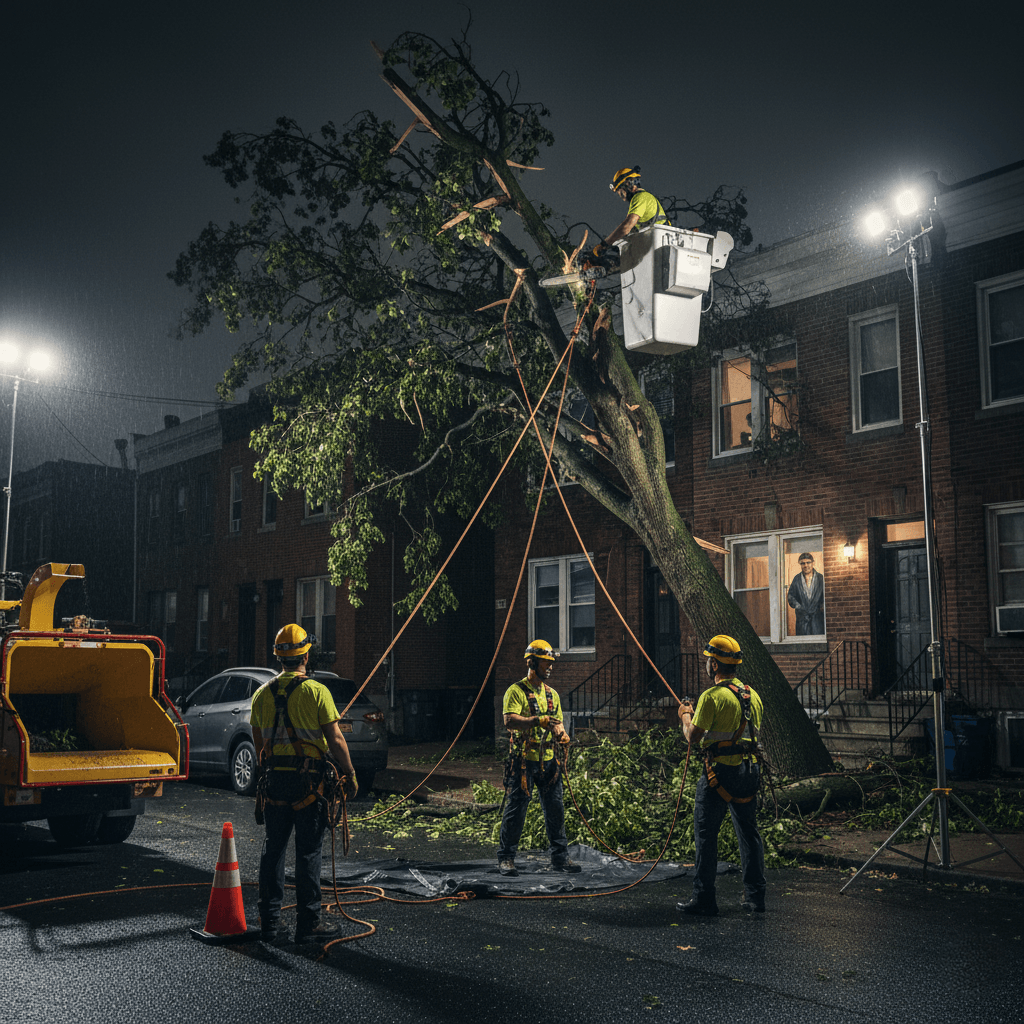
Emergencies have much greater inherent risk than does regular tree work. In emergencies, damaged, leaning, or partially fallen trees will act erratically. Emergency tree work is further compounded by the presence of inclement weather (storms) and/or nighttime working.
Structurally Compromised Tree Hazards
Trees suffering from storm damage will suffer a significant compromise to their structural integrity and, therefore, cannot be thoroughly inspected before commencing work. Internal fractures, torn wood fiber, etc., within the tree will continue to deteriorate until the failure point is reached while the crew is conducting cutting operations. The unpredictable nature of these failures creates a hazard for the crew.
Trees leaning against structures pose a uniquely hazardous removal challenge. The cutting techniques used to remove such trees must protect the adjacent structure from additional damage while controlling the unstable behavior of the tree itself. This delicate balance requires an extraordinary level of technical ability and thus greatly increases the probability of accidents occurring.
The emergency crews serving the properties along Summit Avenue that are impacted by an emergency will be willing to take on the elevated risk; however, this willingness to accept such risk should be compensated with a premium rate. The emergency personnel involved are literally risking their own lives to respond to the emergency.
Unfavorable Work Environments
Emergency responses are most commonly initiated in conjunction with adverse weather conditions (severe storms). Working in high winds, heavy rain, or darkness increases the inherent risks of every aspect of the job. Reduced visibility, slippery conditions, etc., as well as the continuing threat of changing weather conditions, all combine to create an unfavorable work environment.
Nighttime emergency work requires portable lighting systems that illuminate the work site but create shadows and reduce the crew’s ability to perceive depth. The crews must meet the same safety standards as they do in daylight, but the likelihood of error is greatly increased. Such conditions justify the premium pricing.
Specialized Apparatus Requirements
Emergencies require apparatus and equipment that exceed the typical offerings of a tree service. Frequently, emergency crews must utilize cranes, specialized rigging, and heavy-duty equipment to safely address the complexities associated with emergencies.
Emergency Crane Rental
Large trees that have fallen onto structures frequently require the utilization of a crane to safely remove sections of the tree. Emergency crane rentals are billed at premium rates due to the urgency of the situation. Crane services are billed by the hour with a minimum number of hours required before the crew can begin billing, which increases the overall cost of the emergency response.
Transporting cranes to Union City’s narrow residential streets near West Hoboken also poses logistical issues, including street permits, traffic control, and coordinating access, which all add to the emergency response costs.
Portable Lighting & Portable Power Systems
Nighttime emergency work requires the utilization of large amounts of light to create a safe and effective work environment. Portable lighting systems that are professionally designed cost tens of thousands of dollars and include transportation, set-up, and operating costs. These investment costs and operational costs contribute to the premium pricing associated with emergency services.
In addition, the rental fees or fuel costs associated with generator(s) to power the lighting and equipment add additional costs. There are some emergency sites that do not have electricity available to them, and thus require self-contained power systems. These logistical requirements all increase the project costs associated with emergency services.
Greater Insurance & Liability Exposures
Emergency work presents greater insurance risks due to the higher likelihood of accidents occurring and the possibility of additional damage to properties. Insurance companies recognize these increased exposures by charging greater premiums for emergency services.
Potential for Greater Property Damage
Trees that are in contact with a structure are exposed to massive additional potential for damage when removing the tree. A single mis-cut can result in catastrophic additional damage to the property, far in excess of the damage caused by the tree. The liability exposure associated withthe emergency removal of trees that are contacting structures warrants cautious emergency response strategies that prolong the length of the emergency response project.
Worker Safety & Worker Compensation Claims
Higher accident risks associated with emergency operations translate to higher workers’ compensation insurance costs. Insurance carriers review worker compensation claims data and assess premiums based on the increased risk of accidents associated with emergency work. These increased insurance costs must be factored into the pricing of emergency services.
Limitations on Available Resources & Market Competition
Major storms create significant spikes in emergency demand for tree services, which exceeds the available supply of local tree services. As a direct result of the supply/demand imbalance, the prices for emergency services are driven upward by the fundamental principles of supply and demand.
Shortage of Post-Storm Services
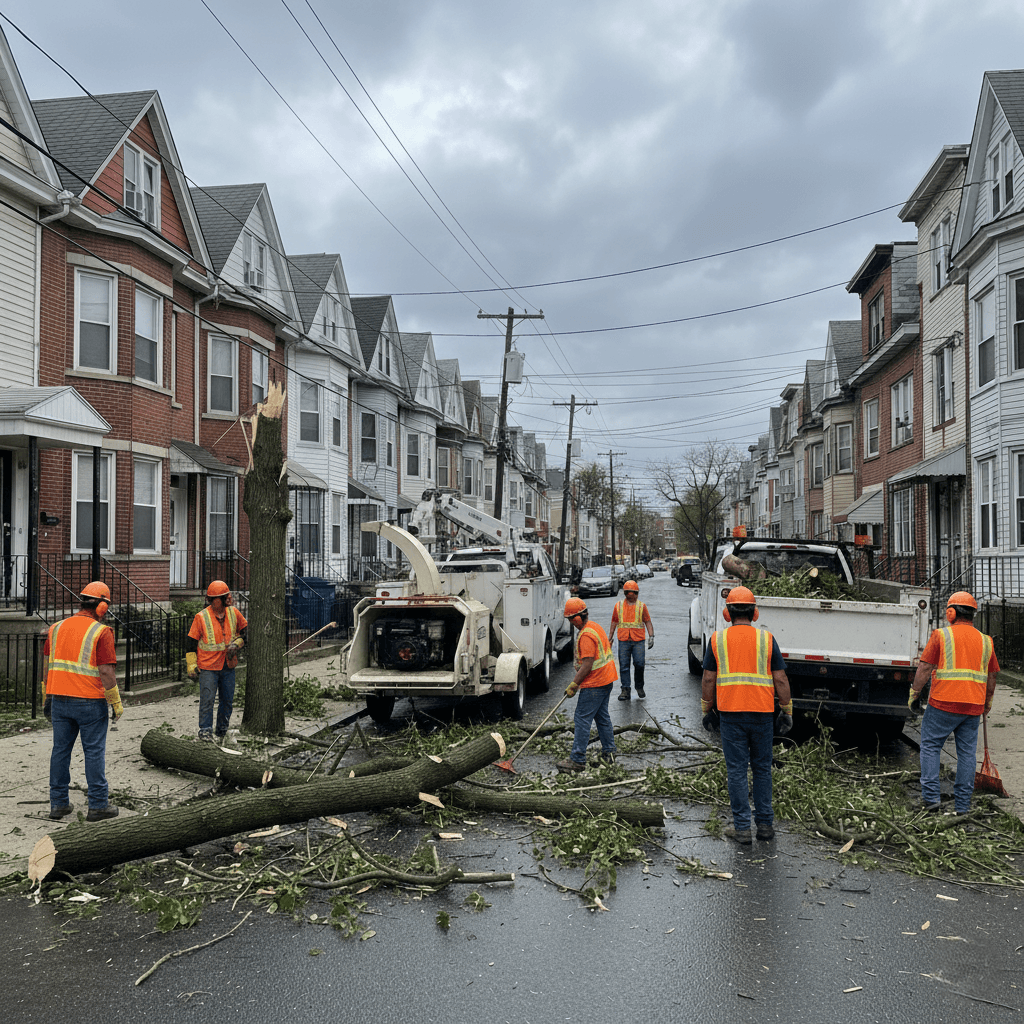
Widespread storm damage results in dozens or hundreds of simultaneous emergency calls. Due to the sheer volume of emergency calls, tree services can attend to only a limited number of emergency situations at a time, resulting in service shortages. Properties that are experiencing an emergency shortage will pay premium prices to receive priority emergency services.
Density of Union City & Neighborhood Concentration
Union City has a dense population, and when severe regional storms hit the neighborhood surrounding Palisade Avenue, numerous properties are affected at the same time, creating a particularly acute service shortage. Local emergency services are prioritized based on the level of danger presented by the emergency, and the relationship between the emergency service provider and the property owner, and not by price sensitivity.
Costs Associated with Bringing in Out-of-Area Contractors
Depending on the location of the storm, out-of-area contractor crews may be brought in to respond to emergencies. These traveling contractors charge premium rates to account for the costs of traveling long distances, temporary housing, and being away from their home territory. Desperate property owners will accept these inflated rates during times of emergency service shortages.
Emergency Complexity
Emergencies are generally more complex than routine removals. Emergency crews must contend with trees in precarious positions, utilities, and structural damage.
Entanglements with Utility Lines
Storm-damaged trees are often entangled with power lines, creating dangerous situations requiring coordination with the utility company. Emergency de-energizing of the utility lines takes time and thus delays the tree removal work while the crew remains on standby. Both the delay and the standby time add billable hours to the emergency response.
Emergency utility line de-energizing may require utility company crews working with tree services. The coordination of such activities complicates the project duration while multiple contractors bill for their time simultaneously. The property owners are responsible for paying the combined costs of the multiple emergency responders.
Temporary Structural Support Requirements
Trees leaning against buildings may require temporary structural support to prevent the building from collapsing or sustaining additional damage while the tree is removed in sections. Providing temporary structural support increases the amount of time, equipment, and expertise required to complete the project.
Removal of trees from structures without damaging the structure demands great precision and planning. Every cut made in the tree must be carefully planned to control the force and movement of each section. This methodical process extends the emergency response time appropriately but increases the total cost of the response.
Urgent Debris Removal & Urgent Debris Disposal
Emergencies require immediate clearance of debris to allow for restoration of access to the property and to prevent additional hazards. Clearing the debris created by an emergency presents logistical challenges that affect costs.
Restoration of Critical Pathways
Fallen trees blocking driveways, streets, etc., require immediate removal so that the critical pathways to the property can be restored, regardless of the ease of debris disposal. Crews may need to make multiple trips to remove critical debris before they can begin a thorough clean-up, adding to both the total labor costs and the total travel costs.
Limitations on After-Hours Disposal
Emergency debris created during nighttime or weekend work cannot be delivered to disposal facilities as quickly as it would be if created during daylight hours. Someemergenciess require the emergency responder to temporarily store debris on-site prior to making a second trip to dispose of the debris. The two-phase process for disposing of emergency debris doubles the labor costs and extends the project duration.
Documentation & Insurance Claim Coordination
Emergencies involving property damage require extensive documentation to facilitate the processing of claims with the insurance carrier. Professional services provide detailed photographs, written reports, and communication with the adjuster to assist with the claim processing.
Requirements for Documentation of Evidence
Insurance carriers require comprehensive documentation before approving emergency removal claims. Tree services must photograph the damage from multiple angles, document the condition of the tree, and document the removal procedure. The time spent documenting evidence adds to the total cost of the emergency response but is crucial to ensuring the successful processing of the claim.
Claims Processing Assistance
Reputable emergency services assist property owners in processing claims with the insurance carrier by providing detailed invoices, assessing the damage, and communicating with the adjuster. The time and resources spent assisting in the claims processing create costs that must be included in the premium pricing of emergency services.
Accelerated Equipment Wear & Maintenance Costs
Emergency services accelerate equipment wear and tear by utilizing equipment continuously in extreme working conditions. This accelerated maintenance requirement and shortened equipment lifespan create costs that must be covered in emergency pricing.
Extreme Utilization Rates of Equipment
Emergency responses often require equipment to operate continuously for extended periods of time. This excessive usage of chainsaws, chippers, etc., creates excessive wear and tear. Equipment replacement parts and major maintenance needs arrive sooner due to the extreme utilization of equipment in emergencies.
Equipment Exposure to Harsh Environmental Conditions
Emergency responders work in or shortly after severe storms, exposing their equipment to rain, wind, and debris contamination. Water corrodes metal equipment, debris contaminates cutting surfaces and mechanical components, etc. This exposure to harsh environmental conditions shortens the useful life of equipment and increases depreciation costs, which must be reflected in emergency pricing.
Opportunity Cost of Emergency Responses
Companies responding to emergencies sacrifice revenue from scheduled work that they cannot perform. This is a real economic loss that must be offset by emergency pricing.
Losses of Revenue from Cancelled Schedules
Each emergency response precludes completion of scheduled work, thereby eliminating a known source of revenue. Companies determine emergency rates based on the difference between emergency call revenue and lost scheduled revenue.
Impact on Customer Relationships
Disruptions to scheduled customer work cause strain on customer relationships despite the legitimacy of the emergency. Companies invest in goodwill and future business opportunities in customer relationships. Emergency responses that damage these relationships create indirect costs that must be paid for through premium emergency pricing.
Professional Judgment Under Pressure
Emergencies require experienced professionals to exercise sound judgment and make quick decisions under intense pressure. The value of this professional judgment is immeasurable during emergencies and must be compensated accordingly.
Expert Assessment of Rapidly Developing Emergency Situations
Assessing complex emergencies requires years of experience and specialized training. Arborist professionals rapidly assess structural stability, potential fall trajectories, and the sequence of removal. By preventing additional damage and injury, professional emergency responders create immense value, which justifies premium pricing.
Emergency Crisis Management
Professional emergency responders remain calm during emergencies, communicate effectively with panicked property owners, and coordinate with other emergency services. The crisis management skills exhibited by professional emergency responders distinguish professional emergency services from less-experienced providers. Property owners throughout Monastery Place benefit from the professionalism displayed by emergency responders during emergencies.
Value Beyond Simple Cost Comparison
The prices for emergency tree service represent actual value by providing immediate hazard reduction, protecting property, and restoring a sense of calm and well-being. Although emergency service prices will be higher than those associated with regular maintenance, the added benefit of avoiding property damage resulting from continued tree decay or secondary failure can justify premium prices.
Value in Damage Prevention
When an emergency occurs, it is likely that there will be additional property damage as a result of the continued deterioration of the tree(s) or secondary failure of other trees nearby. The cost of this damage is usually far greater than the cost of the emergency service to remove the hazardous trees. Therefore, the damage prevention provided by the prompt emergency response is real economic value and therefore justifies premium pricing.
Protection from Liability
In addition to preventing property damage, a professional emergency response also protects property owners from potential liability for personal injury to their neighbor, passerby, etc., or from attempting to remove the hazardous tree themselves. In situations where emotions are heightened, judgment may become impaired, and a professional emergency response provides valuable protection against potential liability claims.
Understanding Fair Pricing vs. Gouging
Property owners need to understand the difference between reasonable emergency pricing and opportunistic gouging. A legitimate emergency premium rate is generally no more than 50% to 150% of the normal rate for a given service, depending upon the specific circumstances surrounding the emergency.
Prices exceeding double standard rates should raise red flags and/or warrant further investigation unless extraordinary circumstances support an extremely high premium rate. If time allows, property owners would do well to ask about the details regarding the emergency surcharge (or fee) applied and to obtain quotes from at least two different providers before making a decision.
However, if the primary focus is solely on obtaining the lowest-priced emergency tree service provider, property owners risk hiring an unqualified operator who does not have the experience, training, equipment, or personnel to properly address the emergency situation.
Union City Tree Experts recognizes that emergencies cause both physical and emotional distress and that during these periods of crisis, transparency regarding pricing is essential to help property owners make an informed decision regarding their emergency needs. Our emergency tree service pricing reflects the true costs of having the ability to respond to emergencies 24 hours a day and assumes the increased risk associated with emergencies. As experienced professionals responding to emergencies throughout the region, we provide safe and timely emergency responses to protect property and restore a sense of calm and well-being for all clients, while providing emergency pricing that accurately reflects the true value of our professional emergency tree services in the complex and unpredictable urban environment.
LATEST POSTS