Menu
Tree Planting Mistakes Union City Homeowners Commonly Make
Tree Planting Union City
The benefits of planting trees are numerous, including enhancing home values, improving environmental conditions, and creating a sense of community through the neighborhood character. Many times, good-natured homeowners in Union City will make unnecessary mistakes, which will result in poor tree health or even loss of trees. The key is understanding what these common errors are so that you can plant your trees with success from day one. As it relates to proper tree planting methods, there are many misconceptions as to what those should be. Therefore, this comprehensive manual has identified the most common errors in planting trees and offers advice on the correct method to grow healthy, thriving trees for years to come in the diverse urban landscape of Union City.
Incorrect Tree Selection Based on Appearance Rather Than Location
Selecting the right tree is the most important step in tree planting. Unfortunately, many homeowners choose trees simply based on how they look, without regard for the environment in which they live. This choice will ultimately doom trees to either struggle or die, no matter how well they are cared for afterward.
Failure to Take into Account Mature Size
You purchase an adorable little sapling from a nursery, and eventually, it will grow to its full mature size. Homeowners often miscalculate the mature size of a tree and end up planting trees in a way that will limit their ability to grow to their full potential. For example, you would not expect a tree that grows to 60 feet tall with a 50-foot wide canopy to grow in a 20-foot space.
Properties located in the compact neighborhoods of Union City have very limited yard space. Therefore, the placement of large shade trees close to homes, utility lines, or property lines will create future conflicts. As trees grow, these conflicts lead to expensive corrective pruning or removal of the tree, which wastes the cost of the original planting.
Homeowners should research the mature height, canopy width, and root area of a tree before purchasing. By doing so, homeowners can plant trees that fit the space that they have available and avoid future problems. Ornamental trees (small) are better suited to the compact yard of an urban setting than large forest trees.
Not Selecting a Tree That Matches the Environment
Every tree species has unique requirements for sunlight, soil, and moisture. Trees that are placed in the wrong type of location (i.e., a shade tree in full sun; a tree that needs lots of water in a dry location) will suffer from chronic stress and weaken the tree permanently.
Soil types, drainage, etc., vary greatly in Union City, depending on the location. A north-facing location receives much less direct sunlight than a south-facing location. Properties located along Bergenline Avenue have different soil types than properties located in the Heights. In order to plant successfully, a homeowner must match the tree species with the actual site conditions.
Researching what types of trees are thriving in the immediate neighborhood will give homeowners a good starting point for selecting the right tree for their yard. Trees that are growing well in the neighborhood will have the same site conditions as your home. Local nurseries and professional arborists will also recommend tree species based on a site assessment.
Planting at the Wrong Depth
Planting a tree at the wrong depth is the most common and detrimental mistake made by professionals when planting trees. Studies indicate that over 90% of professionally planted trees have been planted at the wrong depth. This widespread mistake leads to a variety of problems, including slow decline, stunted growth, and premature death of the tree.
Burial of the Root Flare
When planting a tree, the “root flare” (the area where the trunk meets the roots) should be visible approximately 1-2 inches above the surrounding grade. When this area is buried, the roots of the tree will be deprived of oxygen and will, therefore, begin to die off. Eventually, the roots of the tree will start to circle the trunk and choke the tree. It is common for trees that are grown in containers or wrapped in burlap to have excess soil covering the root flare. Homeowners will often plant the tree without uncovering the root flare, thereby burying the tree 6-12 inches deeper than it was originally planted.
To plant a tree correctly, you must first expose the root flare before digging the planting hole. Remove all excess soil around the root flare until the flare is visible. Once the flare is visible, plant the tree so that the flare sits at the surface of the surrounding grade. As the tree settles after being watered, the roots will settle, and the flare will sit slightly lower than the surrounding grade.
Making Planting Holes Too Large
Digging a planting hole that is larger than the diameter of the root ball will lead to settling problems as the soil settles beneath the root ball and buries the flare of the tree. Just like planting a tree too deeply, the settlement of the soil will result in the roots being deprived of oxygen and will eventually lead to the death of the tree.
A planting hole should be dug exactly to the depth of the root ball and twice to three times as wide. This shallow, wide planting hole will provide enough room for the roots of the tree to expand laterally and will maintain the correct depth for the flare of the tree.
Incorrect Soil Preparation and Use of Amendments
Preparing the soil improperly will create a hostile environment for a tree to grow in, even if the rest of the planting procedure is done correctly.
Too Much Amendment in the Backfill Soil
Many homeowners believe that adding a lot of organic amendments, such as compost, peat moss, or topsoil to the backfill soil, will help the tree to establish itself. What homeowners don’t realize is that using too many amendments creates a drastic difference between the soil in the planting hole and the native soil surrounding the planting hole. This creates a situation where the roots of the tree prefer to stay in the amended soil rather than expanding into the native soil.
Eventually, this creates a pot-bound condition in the ground, and the tree will never truly establish itself. In addition, trees that are planted in this manner will always be more susceptible to drought, windthrow, and nutritional deficiencies because they are forced to obtain all of the necessary resources from the limited amount of amended soil.
Native soil should be used for backfill with the minimal amount of amendment. This creates a uniform soil profile for the roots of the tree to expand into the surrounding native soil.
Not Breaking up Compacted Soil
Urban soils in Union City are often severely compacted due to foot traffic, vehicle weight, and construction activity. This compaction restricts root growth and limits the ability of the soil to absorb water.
If you do not loosen the soil thoroughly around the planting hole, you will be creating a situation that will be detrimental to the establishment of the tree.
Loosening the soil around the planting hole and scarifying the compacted soil in the surrounding area will allow the roots of the tree to expand and the soil to absorb water.
Improper Watering
Watering mistakes are a leading cause of failure of new trees. Underwatering and overwatering are the two extremes that can create problems for young trees. Many homeowners find it difficult to determine the correct amount of water for their trees.
Underwatering During the Establishment Phase
Young trees need consistent moisture during the establishment phase in order for the roots to develop. Many homeowners will provide adequate water for the initial period after planting, but will stop watering too soon. Young trees need to be consistently watered for at least two growing seasons after planting, and sometimes longer, depending on the size of the tree.
Deep watering is preferred during the establishment phase. Shallow watering encourages the roots of the tree to grow upward, whereas deep watering encourages the roots to grow downward and develops drought-resistant root systems.
Properties located in the western part of the city (West Hoboken) with sandy soils require more frequent watering than properties located in the eastern part of the city (Cliffside Park) with clay soils.
Proper watering technique is to deliver water slowly to the soil to allow the water to soak into the soil rather than running off the surface. Soaker hoses or drip irrigation work excellently; hand watering should be continued until the water no longer soaks quickly into the soil, at which time the soil is fully saturated.
Overwatering and Poor Drainage
Overwatering of a young tree will starve the roots of oxygen, and waterlogged conditions will promote root-rot diseases that kill the tree quickly. Some homeowners will unknowingly water their young trees every day, resulting in continuously saturated soil that will harm rather than help the tree.
Young trees planted in low-lying areas or areas with high water tables cannot survive. Either improve drainage, elevate the planting area, or select a species of tree that is tolerant of wet conditions.
Incorrect Mulching Techniques
While mulching is an excellent method to provide benefits to trees, incorrect application methods can cause more harm than good to the tree.
Creating Volcanoes Around Trunks
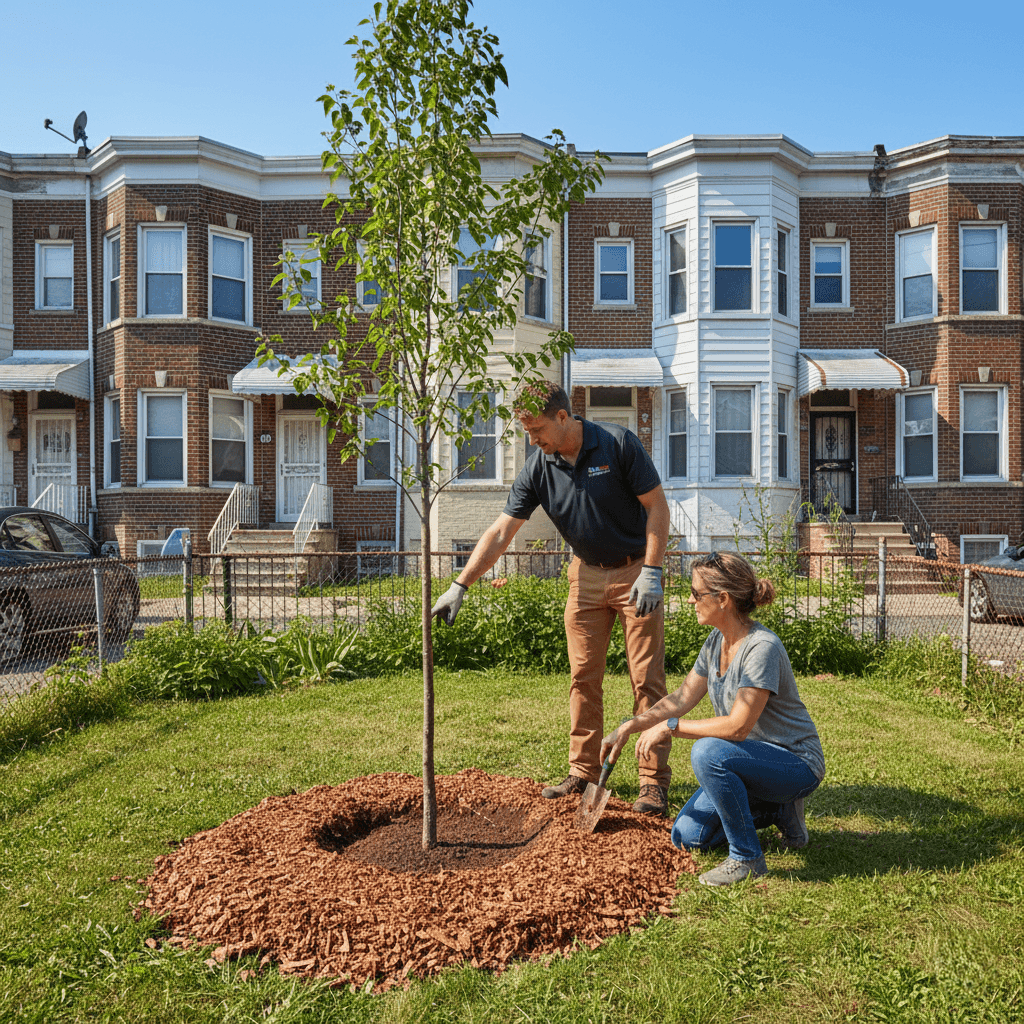
One of the most common mistakes made by homeowners when mulching is creating volcanoes of mulch around the trunk of the tree. Creating these volcanoes of mulch can lead to problems with moisture accumulation and disease. Additionally, mulch piled against the trunk of the tree will eventually begin to decay, attracting pests and promoting further decay.
It is recommended that homeowners apply a 2-4 inch layer of mulch that extends from several inches away from the trunk to beyond the drip line of the tree. Creating a doughnut-shaped ring of mulch with a clear center for the trunk will provide all of the benefits of mulching, while avoiding the problems associated with excessive mulch.
Use of the Wrong Mulch Material
Many types of mulch materials are not suitable for mulching around trees. Some examples include fresh wood-chip mulch (especially mulch created from diseased trees) that can introduce pathogens to the tree; dyed mulches that can contain toxic chemicals; and very fine mulches that will mat together and inhibit water from entering the soil.
Hardwood bark mulch or composted wood-chip mulch is the best material to use for mulching around trees. Hardwood bark mulch breaks down slowly and retains its structural integrity. Composted wood-chip mulch breaks down slowly and does not form mats in the soil.
Failure to Prepare the Root System Before Planting
Container-grown and balled-and-burlapped trees require root system preparation before planting. Not preparing the root system prior to planting will compromise the establishment success of the tree.
Failure to Correct Root-Bound Conditions
Container-grown trees often develop circling roots that continue to grow in a circular motion after the tree is planted. Girdling roots will eventually strangle the trunk of the tree as they grow in circumference. Homeowners who plant trees without addressing the root-bound conditions of the tree are essentially setting up the tree for failure.
Preparing the root system before planting involves gently working loose the circling roots and scoring the sides of the root ball to encourage outward growth. If a tree is severely root-bound, it is best to avoid planting the tree altogether, regardless of its aesthetic appeal. Reputable nurseries take great pains to prevent root circling in their container-grown trees through proper container management.
Leaving Wire Baskets and Burlap Intact
Balled-and-burlapped trees typically arrive with wire baskets and burlap wrapping the root ball. While natural burlap will eventually decompose, synthetic burlap and wire will impede root growth. Removing or cutting the wire baskets and synthetic burlap will improve establishment.
At a minimum, homeowners should remove the wire baskets and synthetic burlap from the upper portion of the root ball (about 1/3 to 1/2) after placing the tree in the planting hole. This will allow the surface roots of the tree to expand out into the surrounding soil. Removing all of the wire baskets and synthetic burlap is ideal, but it is often a delicate process to handle the root ball.
Failure to Choose a Good Location for Planting
More than any other single factor, the location in which a tree is planted will affect its success.
Planting Trees Near Buildings
Trees planted near buildings will eventually develop root systems that can damage building foundations, invade plumbing, and crack sidewalks. Additionally, branches will encroach upon roofs and gutters. These conflicts will arise as the tree matures and can only be resolved by either expensive corrective pruning or removal of the tree.
When planting trees, there must be sufficient space to allow the mature tree to grow away from any obstacles. Small trees should be planted at least 10 feet away from any obstacle, medium trees 20 feet, and large trees 30 feet or more.
Failure to Identify Underground Utilities Before Planting
Trees planted over underground utilities will eventually develop roots that infiltrate the pipes and will make it difficult to gain access to the utilities for maintenance purposes. Trees planted over utilities will eventually have to be removed to allow for access.
Homeowners should always contact 811 before digging to locate underground utilities. When choosing a location to plant a tree, homeowners should attempt to locate the utilities and plan to leave enough clearance to allow the roots of the tree to grow and allow for access to the utilities.
Placing Trees Under Power Lines
Trees planted under power lines will eventually conflict with the power company and will need to be pruned continually. This continual pruning will disfigure the tree and will cost homeowners money. If the homeowner fails to prune the tree, the power company will eventually remove the tree at the homeowner’s expense.
Homeowners should only plant small ornamental trees under power lines and limit the mature height of the tree to 25 feet. Larger trees should only be planted in locations where there are no overhead obstructions.
Improper Staking and Support
Tree staking can be helpful when done correctly. However, many homeowners do not know how to properly stake a tree and will use staking techniques that will actually harm the tree.
Over-Staking Small Trees
Many small trees do not need to be staked at all. Unnecessarily staking a small tree will prevent the natural trunk movement that helps to strengthen the trunk. Trees that are staked unnecessarily will develop weak trunks and will be unable to support themselves when the stakes are removed.
Trees that should be staked include trees that are exposed to high winds, trees with small root balls relative to their canopy, or trees that are planted on slopes. Even when staking is necessary, there should be enough flexibility in the stake system to allow the trunk of the tree to move slightly for trunk strengthening.
Leaving Stakes in Too Long
Tree stakes should only remain in place for a maximum of one year, and usually less for smaller trees. Leaving stakes in place for extended periods of time will prevent the proper development of the trunk of the tree and create dependence on the stake. If the stakes are left in place for too long, they can girdle the trunk of the tree and cause significant damage.
Homeowners should inspect the stakes on trees regularly and remove them as soon as the tree is strong enough to stand on its own. When staking a tree, homeowners should use flexible tie systems to prevent damage to the bark and allow for some movement of the trunk.
Neglecting Immediate Post-planting Care
Neglecting immediate post-planting care is an area of importance to the success of the establishment of new trees. Most homeowners plant their trees and then fail to follow up with proper after-care.
Overlooking Initial Pruning
Pruning (corrective) is sometimes necessary on newly planted trees to trim back some damaged branches or to fix structural problems. However, over-pruning can remove too much foliage, thus reducing photosynthesis and the tree’s ability to produce its own food. Finding the right balance between making some corrections and preserving enough foliage to allow for continued photosynthesis requires professional judgment.
Some minor structural pruning may be required to address obvious problems, but most major pruning should be done once the tree has had time to become established and has the capacity to withstand loss of part of the canopy.
Ignoring Ongoing Monitoring
Continual inspections during the first few years will identify potential problems early on when they are easier to solve. Inspect the soil for moisture, look for signs of pests, monitor foliage for disease or other conditions, and ensure that there are no girdling ties or stakes on the tree. Vigilance during this period will prevent small problems from growing into big ones.
Planting at the Wrong Times
Timing greatly impacts the success of planting. Although container trees can be planted almost anytime, planting at the best times will give your trees the greatest chance of successful establishment.
Challenges of Summer Planting
Planting in the heat of the summer presents two challenges to the establishment of new trees. The first challenge is the high demand for water by the tree as it tries to develop its root system. The second challenge is the extreme temperatures associated with the heat of the summer. During the same time that the tree is trying to establish itself, it is also experiencing heat stress. If you do have to plant in the summer, it is essential to maintain constant watering and inspect the tree frequently for signs of distress.
Fall and Early Spring Are Ideal Planting Windows
Moderate temperatures combined with sufficient moisture make fall and early spring the perfect time for planting. With fewer heat stresses, your trees will be able to focus on developing their roots and establishing themselves quickly and with minimal maintenance.
Why Hire a Professional to Plant Your Tree?
While homeowners can successfully plant trees, hiring a professional to plant your trees provides the expertise and equipment to maximize the chances of successful establishment. A professional arborist understands how to select the right tree species for your specific location, how to properly prepare the planting site, and what type of ongoing care your tree will require.
If you are planting a tree that is highly valued or is very large, investing in the services of a professional arborist will pay off in the long run. Professional arborists have the knowledge, skills, and equipment to ensure that the tree is planted correctly, which includes the correct depth, soil preparation, and initial care. By providing a strong foundation, professional arborists enable your tree to grow for decades to come, providing years of enjoyment and value to your home or business.
At Union City Tree Experts, we know that the way your tree is planted lays the foundation for years of healthy growth and enjoyment. That is why our company offers professional tree planting services that protect homeowners and businesses from the pitfalls of poor planting practices through expert tree species selection, proper site preparation, and correct tree planting techniques. Whether you’re looking for advice on selecting tree species that will thrive in your Union City yard or would like the assistance of a professional arborist who can plant your tree to guarantee success, our team has the knowledge and experience necessary to achieve optimal results. Our professional arborists will guide you through every step of the process, from site assessment to establishment care recommendations, to create a beautiful landscape transformation of your vision into a thriving reality, eliminating the costly errors made by many well-meaning individuals attempting to plant trees in our community.
LATEST POSTS